Falling Frequencies
Ever since I was a child, I have been fascinated by the shape of snowflakes. I remember one particular snowfall clearly. I had just purchased a brand-new black ski jacket, and the snow was falling so softly that the individual flakes caught my attention as they landed on my arms. I stood there staring at them, amazed by the perfect geometric forms they displayed. No two flakes were alike. I remember wondering how such precise creations were possible. Were they being manufactured somewhere in the clouds above me? carefully being shaped before falling to the ground? The forms reminded me of finely crafted pieces of art. It was a moment of quiet awe, one that has stayed with me ever since.
I also remember that the conditions were just right for this to happen. At other winter times, snowfall appeared clumpy and indistinct, the delicate forms lost as flakes gathered together. Years later, I came across the work of a Japanese researcher, Masaru Emoto, who conducted experiments involving frozen water droplets. He spoke positive words and affirmations to water before freezing it and observed beautifully formed crystalline structures. When he spoke harsh or negative words, the frozen results appeared distorted and chaotic. His findings mirrored what I had observed all those years ago. This left me wondering whether it was all coincidence, or whether something deeper, something beyond simple chance was at play. Snowflakes aren’t just weather. They’re math briefly made visible, landing on your sleeve before disappearing again.
As I continued exploring various pieces of information throughout my life, I was always drawn most strongly to the scientific side of things. Science can explain a great deal, not everything, but enough to spark curiosity and send you chasing an idea down a rabbit hole. That curiosity led me to mathematical fractals, and from there to vortex mathematics, both of which attempt to describe the same recurring phenomenon seen in the Fibonacci sequence.
In simple terms, these patterns appear everywhere in nature: the spiral of a crustacean shell, the geometry on the backs of turtle shells, the veins of leaves, the branching of tree roots, the structure of branches, lakes, and river systems. Over and over again, nature seems to fractal, spin, twist, and emerge into familiar shapes. The question that kept returning to me was simple, why this pattern? Why does nature choose this method of growth?
Personally, I do not believe coincidences exist. I believe that a greater power, God himself left fingerprints across creation. From the branching of our lungs to the formation of seeds, vegetables, plants, birds, and animals, life seems to share this same method of growth. Again and again, the same vortex-like mathematics appears, repeating across scales and forms. In many ways, it feels as though this repetition is where what we call “coincidence” or “Synchronicity” originates.
Consider something simple and human. Imagine cooking a spaghetti dinner. Not just any spaghetti, but very specifically: ground turkey instead of beef, extra parsley, and vodka sauce instead of traditional marinara. In modern times, our lives are quietly documented through social media. A year later, an app reminds you: On this day last year, you cooked the same meal. Same date. Same dish. Same choices. Why does that feel so unsettling, and familiar at the same time?
To me, this is vortex mathematics and the Fibonacci sequence expressing themselves through human behavior. Cycles repeating. Patterns resurfacing. Not consciously planned, yet uncannily precise.
This line of thinking naturally leads into areas where science still struggles to offer complete explanations like human intuition, extrasensory perception, and what some describe as the human plasma or electromagnetic field. Take something as basic as pull-ups. You look at the bar, you assess your body, and almost instantly you know how many you can do. Two. Maybe three. But no more. How do you know that without testing it first?
I believe this knowing comes from a field that extends beyond the physical body an intuitive sensing system that reads both environment and self in a fraction of a second. It is a sense most people experience but rarely acknowledge. And yet, the clues are everywhere, woven into our bodies, our actions, and the repeating patterns of the world around us. The universe seems to prefer patterns that return to themselves.
Tesla and Three Six Nine
Tesla was not worshiping numbers he was recognizing harmonic roles. Now add geometry. Three points define a plane. Six directions define space around a center. Nine often appears as a completion cycle (3 × 3). In rotational systems coils, magnetic fields, turbines, and generators symmetry and repetition matter more than straight-line measurement. Tesla didn’t see the universe as linear; he saw it as circulatory.
The Human Presence
As our plasma field extends outward, and if a person is filled with positive, joyous thoughts, I begin to wonder, if emotions and words can influence water to take on harmonious designs, is it not possible that snowflakes themselves are being affected by our own presence? Do we not carry an energy with us? Do household plants not thrive more under the care of a loving, attentive gardener? Do animals not respond better to a zookeeper who genuinely cares for them? Is it not human presence, our emotions, our intentions, our vibrations that shapes the world around us?
Are we not connected to heaven, to the heavenly bodies above us? Do our emotions not extend outward, perhaps farther than we realize? Do prayers work? Can we close our eyes and pray to Jesus to fill us our bodies, our lands, our families with love, compassion, and mercy? And when we do, are the shapes and patterns around us not indicators, subtle reflections, of what we carry within? Are the beautiful snowflakes I witnessed not proof of the love that radiates outward from us ?
Frozen Cymatic Frequencies
Leonardo da Vinci, one of the greatest artists the world has ever known, remains a mysterious figure. How does one come to possess such extraordinary talent? Was it a skill honed through discipline alone, or was it a gift—perhaps even a heavenly one? No one can say for certain. What can be said is that he worked with intention and purpose. He carried vision upon vision within him. Whether sculpting marble, painting cathedrals, or filling notebooks with inventions far ahead of his time, his body of work is so vast and so refined that it is difficult to believe it came from a single man.
One of his works that stands out most to me is the Mona Lisa. I admit, I have never seen it in person. From photographs and videos, it does not strike me as overwhelmingly impressive in a technical sense, perhaps it was more so in its time. The figure itself is subtle, almost ambiguous. It is not immediately clear who the subject truly is, or even whether the figure is meant to be distinctly male or female. And yet, millions travel across the world to stand before it.
Da Vinci was not only an artist; he was an inventor, a creator, a man deeply attuned to possibility. To possess such creative depth suggests a mind operating at an elevated level of focus and awareness. I believe his intentions were filled with curiosity, optimism, and a deep concern for humanity. A truly creative mind carries love, divinity, and mindfulness of the greater whole.
It is my belief that while he painted, the liquid paint itself resonated with his intense focus and intention. As his mind worked, as his thoughts aligned with vision and purpose, those intentions carried a vibrational quality. The wet paint, still fluid and receptive, may have responded to that energy, forming and holding patterns much like cymatics, the visible shapes created by sound vibrations. Once dried, those vibrations became frozen in place, locked into the work forever.
What fascinates me is that these cymatic forms often resemble snowflakes! complex, symmetrical, and subtle. Could it be that the enduring popularity of the Mona Lisa is not solely due to its composition or technique, but because it carries something deeper? Could the painting itself act as a tuning fork, resonating with something within us? Is it possible that the vibrational imprint of da Vinci’s focused intention remains embedded in the work, quietly influencing those who stand before it?
Perhaps one day this idea will be explored more deeply. Until then, I see the Mona Lisa not as a simple painting, but as a vessel holding something unseen, something felt rather than measured, waiting to be understood. Just like the falling snowflakes I witnessed so long ago.
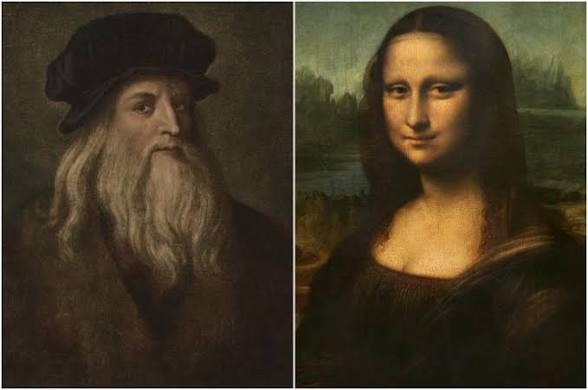
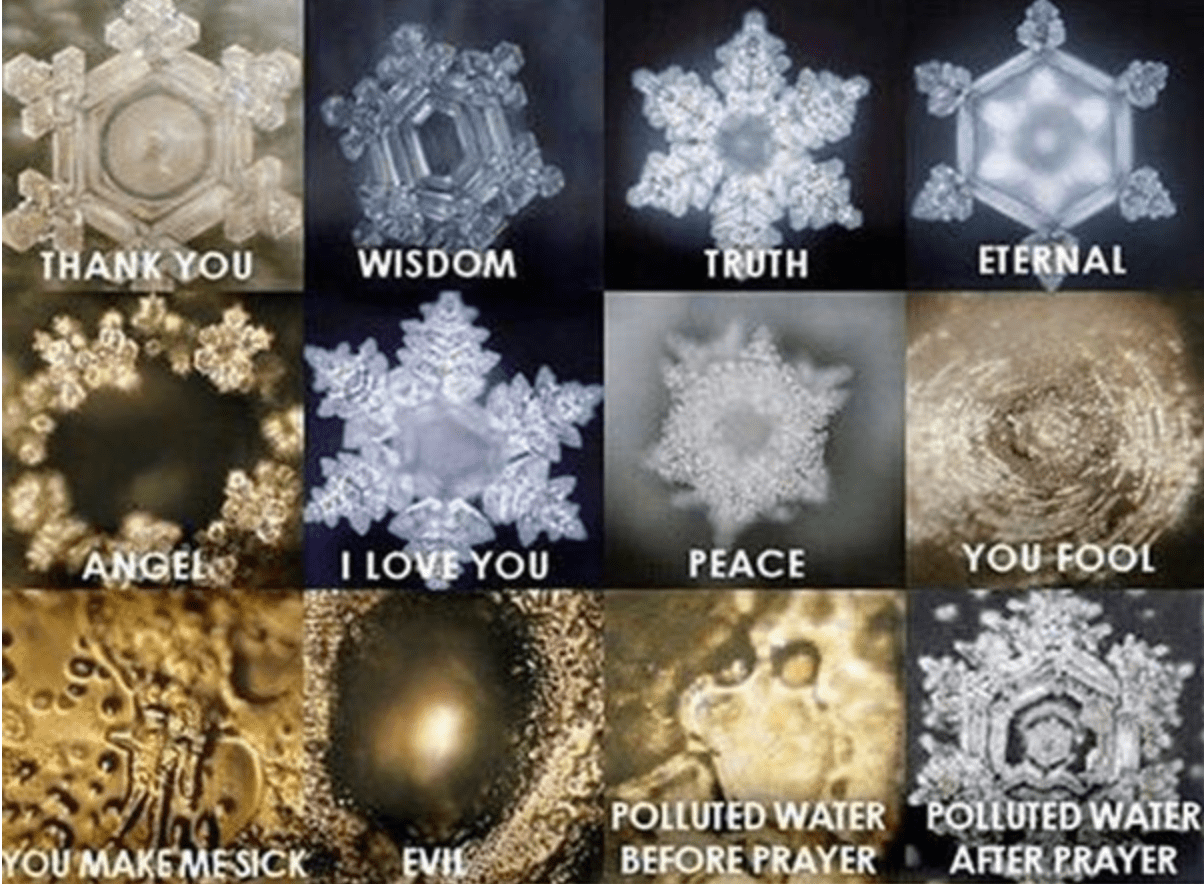
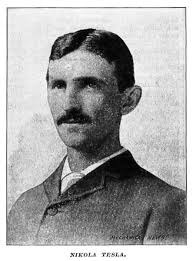
Leonardo da Vinci pictured next to one of his most famous paintings, the Mona Lisa. It is an interesting thought that his vibrational frequency, which he emanated, is frozen within this painting. The frozen ice crystals of the Japanese doctor’s experiments, thanking the water, saying positive thoughts versus the negative ones, the examples shown here. And Dr. Nikola Tesla, the inventor who always proclaimed the significance of the numbers 3, 6, 9, and integral part of his discovery of the rotating magnetic field from the vortices mathematical concepts.


