
Le Prix Guzman – The Guzman Prize
In the year 1900, the French Academy of Sciences quietly accepted one of the most unusual bequests in scientific history. It came not from a prominent physicist, inventor, or explorer, but from a grieving mother in Paris—Madame Guzman, who had lost her son, Pierre, a young amateur astronomer with dreams fixed on the stars. In his memory, she created a prize. But not just any prize. The Guzman Prize was a reward for a feat so ambitious, so outrageous, that it bordered on the mystical: successful communication with a celestial body.
There was only one stipulation. Mars, she said, was too easy.
Madame Guzman, despite her quiet place in the world, carried a vision that surpassed the ambitions of her time. She believed Mars was likely to be the first planet we reached or contacted, and that our real challenge was to go beyond it. Her condition to exclude Mars elevated the prize from scientific novelty to spiritual dare. Her grief was transmuted into something far-reaching: an invitation to humanity to step outside itself, to make contact with the truly unknown.
Camille Flammarion, France’s most poetic astronomer, stood at the heart of this vision. He wrote La planète Mars in 1892, blending rigorous scientific observations with spiritual speculation. Mars, to Flammarion, was not just a planet, it was a mirror. He studied its polar ice caps, its canals, its changing seasons, but he also imagined its inhabitants. To him, intelligent life on Mars might be wiser than us, more moral, more harmonious. The planet was both a scientific object and a spiritual ideal.
The Guzman Prize emerged from that intellectual atmosphere: a Paris where astronomy and spiritualism walked hand in hand. Where telescopes were instruments of both optics and prophecy. Where the boundaries between science, grief, mysticism, and ambition dissolved in the open sky.
Over a century later, the prize is nearly forgotten, a footnote in the history of space exploration. But its spirit survives. Every attempt to contact alien life, every scan of the heavens, every SETI broadcast, and every Mars rover that sends signals back to Earth—all echo that first human hope to be heard across the void.
But sometimes, stories loop back on themselves in strange ways.
Guzman is not just a name in a Parisian will. It is a name alive today. And now, another Guzman is telling a story A story where interplanetary communication, cosmic symbols, and sacred design are once again merging. A story where self-sanitizing suits, copper bricks, and time distortions connect not just planets, but epochs. A story about a future that looks backward, and a past that saw far ahead.
If Madame Guzman’s wish was to honor her son’s passion for the stars, it has traveled farther than she could have dreamed. The prize she created was never truly about reaching Alpha Centauri. It was about reaching for meaning in the great silence. And now, across time and imagination, a new Guzman is listening, and transmitting.
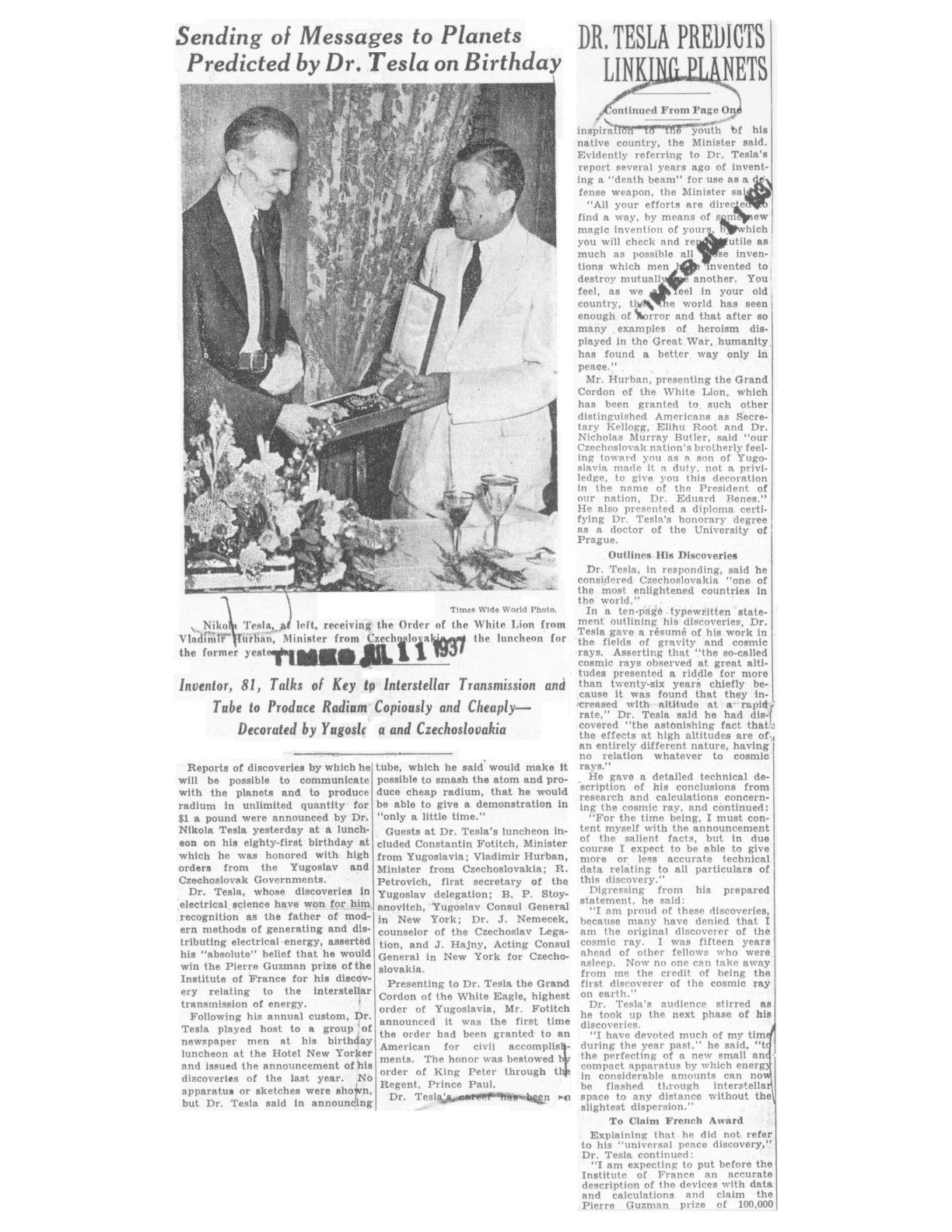
When the Guzman Prize was formally announced in Paris, its conditions sent ripples through the world’s scientific circles. One hundred thousand francs, an astronomical sum at the time, would be awarded to the first person to establish communication with a celestial body beyond Mars and receive a verifiable reply. But the prize was more than a financial incentive. It was a philosophical provocation, an open call to those who believed that the stars were not silent, and that the distances between worlds could be bridged by intelligence, will, and technology.
Nikola Tesla heard the call immediately. At the time, he was deep into his experiments on wireless power transmission, building coils and towers that he believed could transmit energy and messages not just across continents, but across planets. His Colorado Springs experiments in 1899 had left him convinced that he had intercepted an artificial signal, possibly from Mars.
When he learned of Madame Guzman’s extraordinary prize, Tesla saw both a confirmation of his life’s work and a potential lifeline. He was desperate for funding. J.P. Morgan had already grown cold to his Wardenclyffe Tower project, and Tesla’s vision for global wireless energy was hanging by a thread.
Whether or not he spoke directly with Madame Guzman, Tesla made his intentions known in Paris. While in France, likely in the orbit of the Exposition Universelle, and perhaps during his fabled visit to Gustave Eiffel’s summit apartment. He is believed to have discussed the prize and his qualifications for it. In Tesla’s mind, his wireless system was not just a tool of convenience; it was a universal transmitter, a bridge between species and spheres. The Guzman Prize was not a detour from his tower, it was a way to save it.


