If you were from the future, how would you prove it?
Would you describe events that haven’t happened yet? Or would you only have fragments, small pieces of something larger that you can’t fully reconstruct in the present? Sometimes a fragment is enough to suggest something larger exists behind it, especially when it resembles technology that feels out of place for its time.
If someone from today, 2026, were placed in the distant past and tried to describe a modern iPhone, the first reaction wouldn’t be belief. It would be demand: build it. Show it. Prove it. And yet almost no one, even today, could build a modern iPhone from scratch without entire global systems behind them, semiconductor fabrication, supply chains, software ecosystems, precision manufacturing, and decades of accumulated engineering.
I tend to think in terms of systems that don’t exist yet, how things could be built differently, how tools might evolve, and how daily life might function if technology became seamless, efficient. Sometimes those ideas don’t come to me as structured plans. They come as dreams. And I want to try to explain one of them.
Have you ever had a dream so real that it stayed with you, something that didn’t fade the way most dreams do?
In 2020, the world entered a period that changed how people thought about proximity, contact, and even everyday awareness. New behaviors became normal almost overnight. Masks, distancing, sanitization, things that were once background details of life became central to it. Attention shifted toward invisible things, especially germs, risk, and transmission. The way people moved through space and interacted with each other changed noticeably.
Looking back from 2026, it almost feels like a compressed chapter of history, something intense that has since softened, like the world gradually returning to older rhythms of life.
During that time, I began having dreams that felt unusually structured and persistent, almost like they were trying to communicate something rather than simply unfold randomly. One of those dreams is something I still think about often. I call it The Spheretery, a word I created by combining sphere and secretary.
The Spheretery
In the dream, I was walking through what felt like a massive store or warehouse, part arcade, part retail space, part something I couldn’t quite categorize. Lights were everywhere, reflecting off polished surfaces, and the whole place had the feeling of a system designed more for experience than commerce.
I was being led by a young woman toward the back of the building. It didn’t feel like a casual tour, more like I was being guided toward something specifically, possibly a meeting, though I was never told directly.
But I kept getting distracted.
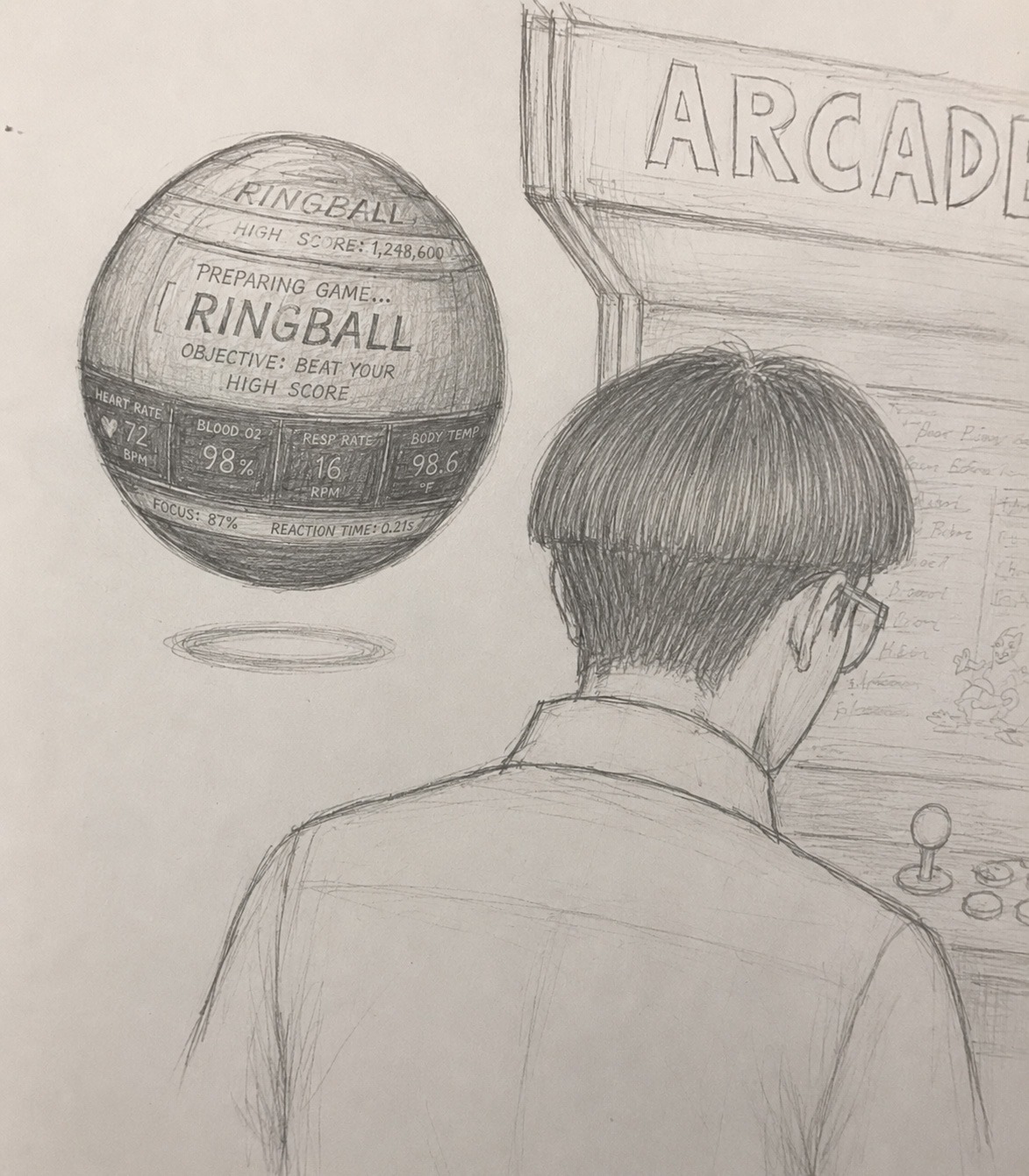
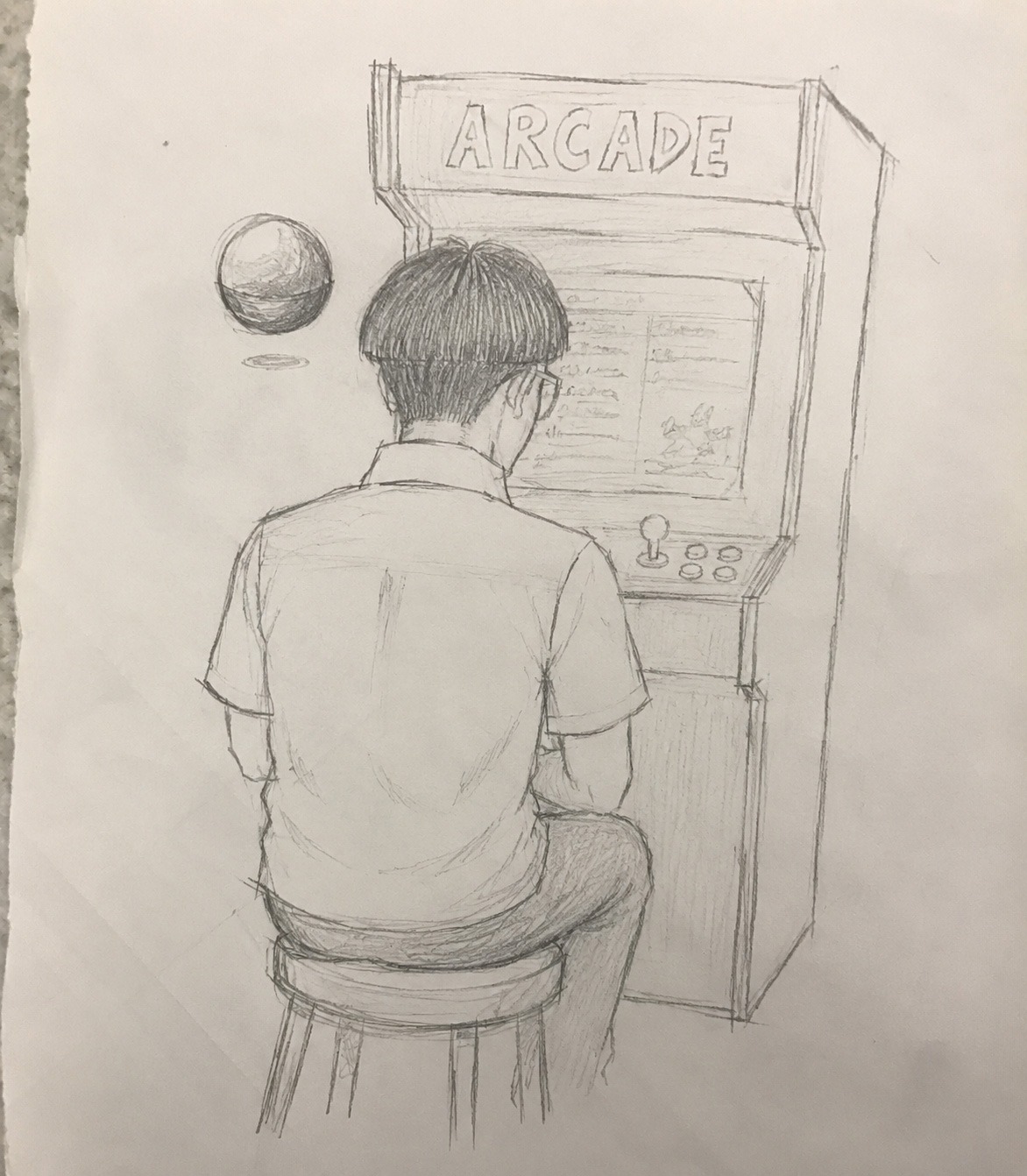
At one point, I stopped following her entirely because of a man sitting alone at a machine I had never seen before. It looked like an arcade cabinet, but instead of a screen-driven game, it involved physical ball bearings dropping onto other arranged and stacked ball bearings, triggering collapses, chain reactions, and scoring patterns based on how structures fell.
What held my attention wasn’t the game itself, it was what hovered above him. Above his right shoulder was a floating sphere. It wasn’t decorative. It was informational. It displayed rotating lines of text like a living interface. Some messages explained his behavior in real time:
“He is currently on his only day off.” “He is attempting to beat his personal high score.”
“Please do not interpret his silence as irritation or disengagement.”
“He is fully concentrated on his preferred activity.”
Other layers of data cycled through as well, far beyond anything I would normally associate with public information. It displayed his vital signs: heart rate, blood pressure, and other physiological readings. It even tracked subjective states, translating them into percentages: hunger, focus, cognitive engagement.
At times, it appeared to indicate which regions of the brain were active, as if attention itself had been mapped and externalized. It felt like a complete translation of internal reality into visible language. The sphere also rotated through more general statements and simple phrases like “peace,” “love,” and “friendship,” as if personal data and social expression were layered into the same system.
The most unsettling part was how normal the man seemed with it. He did not react to the sphere at all. His attention remained entirely on the game. At some point, I became aware that I had stopped following the woman guiding me. I remember, faintly, the frustration in her body language, an almost physical reaction to me breaking away from the path I was supposed to be on.
But I couldn’t stop watching the sphere. It felt like I wasn’t just observing the man anymore, I was observing a system that had turned human behavior into something fully visible, fully explained, and constantly updating in real time.
After multiple layers of messages and displays, the system settled into a final transmission. A full message appeared, clear and centered:
“Greetings all… Today I will play Ringball. I will attempt to surpass my score of 28,000. This will not be easy. I will be concentrating deeply on this task. The Spheretery will display my status as I focus on the game. Peace, love, truth.”
The message lingered for a moment, then slowly rotated away. The screen refreshed, transitioning into a different kind of display, something more fluid, more abstract unique to the device itself. It no longer relied on words. Instead, it began to show a live visual expression of the user’s state, shifting in real time as the mind engaged with the task ahead.
When I woke up the next morning, the feeling stayed with me. It wasn’t just a dream you forget over coffee, it lingered. I remember sitting there thinking, that was incredibly vivid. For a moment, I could’ve sworn I had been somewhere else. Japan, maybe. That was the feeling.
Almost immediately, I began sketching what I had seen, trying to hold onto the details before they slipped away. The figure in the dream was a man, somewhere between 25 and 35. He wore glasses and a light blue, short-sleeve, button-up shirt neat, simple. Hovering just above his right shoulder was the device.
Even in the dream, I understood it without needing it explained. This was what had replaced phones. There was no reaching into pockets, no looking down at a screen. The message was simply there displayed, visible, shared. A floating pin of expression, projecting exactly what the user wanted others to see.
As I sketched, still half in that state between sleep and waking, I remember thinking how natural it felt. How obvious. Of course this is where things would go. No more mindless scrolling, no more constant handling of devices, just a presence, hovering beside you, quietly broadcasting thought, intention, or feeling.
In the days that followed the dream, one I still find myself thinking about a few times a week, small flashes of detail would return unexpectedly. It never felt like I was actively remembering it so much as it was returning on its own.
I would picture the man at the end of his day, returning home and removing the Spheretery from his shoulder, placing it onto a charging dock. And then, another layer would appear. The device didn’t simply display the present moment, it recorded it.
At the end of each day, everything the Spheretery had observed could be reviewed, almost like scrolling through a personal archive. I could see him sitting at a computer, reviewing his day as though it were captured footage. Not just his actions, but his presence in relation to others.
When two users passed each other during the day, the system recognized it. Their devices identified one another. Later, while reviewing the day, you could select a person you had crossed paths with, click on their face as it appeared in the timeline, and a prompt would appear: Would you like to connect?
If the person didn’t have a device or account, there was nothing attached to them, no name, no data layer, just a passing presence with no digital footprint.
But if they did, information could surface over their image: name, social profiles, public links, even preferences or relationship status. The system seemed designed to overlay identity onto proximity itself.
In this way, a day could be relived, not just remembered, but replayed. Every encounter became searchable, every passing moment potentially revisited. People could be followed retroactively, connections made after the fact, decisions deferred until the end of the day when everything had already been recorded.
Even things like being single, looking for friends, or being in a relationship could be displayed as part of that hovering profile layer, any information someone chose to make visible, or that the system could infer.
There were other flashes, smaller moments of revelation that would surface in the days after the dream.
One detail that stayed with me was how the device responded to physical discomfort. I remember clearly seeing the man touch his jaw, almost absentmindedly, as if checking a dull ache. The Spheretery immediately registered it.
A subtle overlay appeared in the air beside him, mapping the sensation with unusual precision. It identified the source of the pain and asked, calmly and directly:
“Is it your lower bicuspid?”
There was a slight pause, a small nod of confirmation.
The device acknowledged it and responded:
“Dental appointment recommended.”
And just like that, it proceeded to schedule it.
It wasn’t just observational, it was participatory, constantly translating the body into readable information and immediate visual display for it ( The Spheretery ) to cast.
At other times, the Spheretery felt less like a medical or social tool and more like a device designed for truth itself. In a world already saturated with altered images, filtered experiences, and increasingly artificial media, the idea that something might emerge to restore directness, unfiltered presence, unedited reality felt like the underlying direction of it all.
The Spheretery , in these moments of reflection, seemed to represent that shift. A system where what was shown was not curated or edited, but simply registered as it was. A new kind of transparency layered onto everyday life. In that sense, it wasn’t just a device for communication or tracking. It was a device for making reality harder to distort.
Where do Inventions come from?
During the height of the pandemic, I remember thinking constantly about contamination, how easily it spread, how often it came from the most ordinary surfaces, the things we all touch without thinking. That line of thought started to extend into the future. I found myself wondering what solutions would eventually emerge from this period, and more specifically, what the restroom of the future might look like.
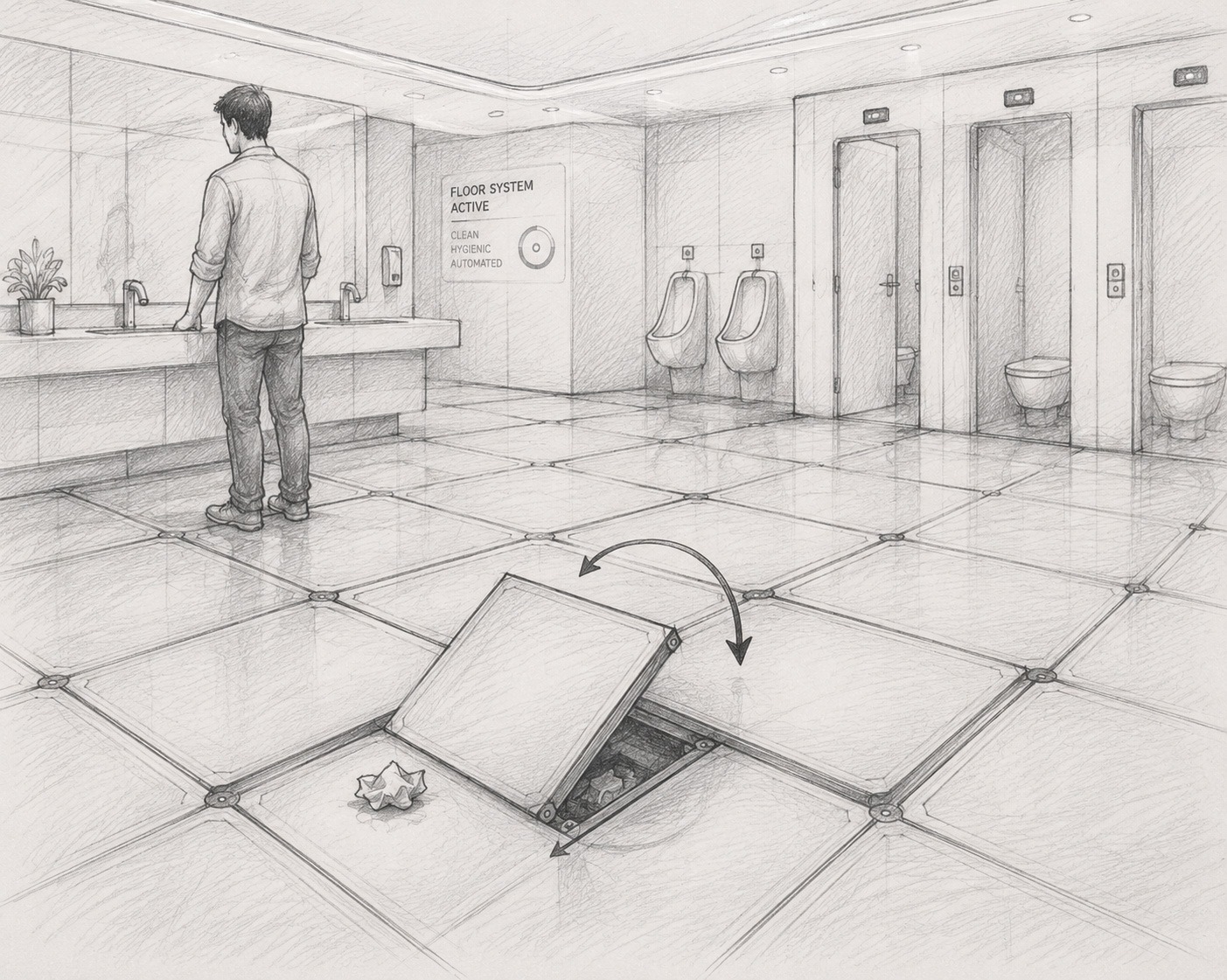
In that same mental space where “The Spheretery” concept had appeared, an idea formed. It wasn’t about more cleaning devices, like the small circular robots that vacuum and scrub floors today. Instead, I imagined something that made them unnecessary altogether. A floor that could clean itself. In this vision, restroom floors were built from advanced tile systems layered with antimicrobial materials, copper and zinc integrated directly into the surface. But the more unusual part was how the system behaved. Each tile was capable of sensing its own condition in real time.
When dirt, moisture, or even a small piece of trash appeared on the surface, the tile would detect it immediately. Rather than relying on external cleaning, the tile itself would rotate, flipping to reveal a fresh, unused surface on top. The contaminated side would then cycle underneath, where it would be cleaned and reset for future use.
Even small disturbances, like a crumpled piece of paper or a spill, would trigger this response. The surface would subtly reconfigure itself, always presenting a clean layer outward, as if the room was actively managing its own condition.
In this imagined system, cleanliness was no longer something performed after the fact. It was continuous, automatic, and embedded into the structure itself a constantly renewed environment, one where the floor itself participated in maintaining hygiene.
Inventions Begin In The Mind
As I pondered the futuristic concepts I was receiving it did make me wonder how long smartphones will actually last. Is it possible they’ll eventually fall out of favor? We’re already at a point where people are starting to recognize the problem, these devices we keep in our pockets that constantly demand attention. They’ve changed the way we focus. In some ways, they’ve made us dependent, always reaching, always checking, always pulled outward. It made me wonder if the Spheretery is, in a way, the next step after the phone. Not just a replacement, but an evolution of it. Because the Spheretery doesn’t feel like something you hide behind or retreat into. It exists outwardly. It reveals instead of conceals. It shows state, intention, and presence in real time. You can’t easily filter yourself through it, or disguise what’s being displayed in the same way you can with images or curated posts. To me, it began to feel like a possible response to a problem, one where the Smartphone, or devices like it, no longer sit at the center of everything. Not because technology disappears, but because it changes form. And in that imagined shift, the Spheretery felt like something that belonged to that next stage.